Lender Questionnaires
Condo and HOA Lender Questionnaires, Answered From Your Records
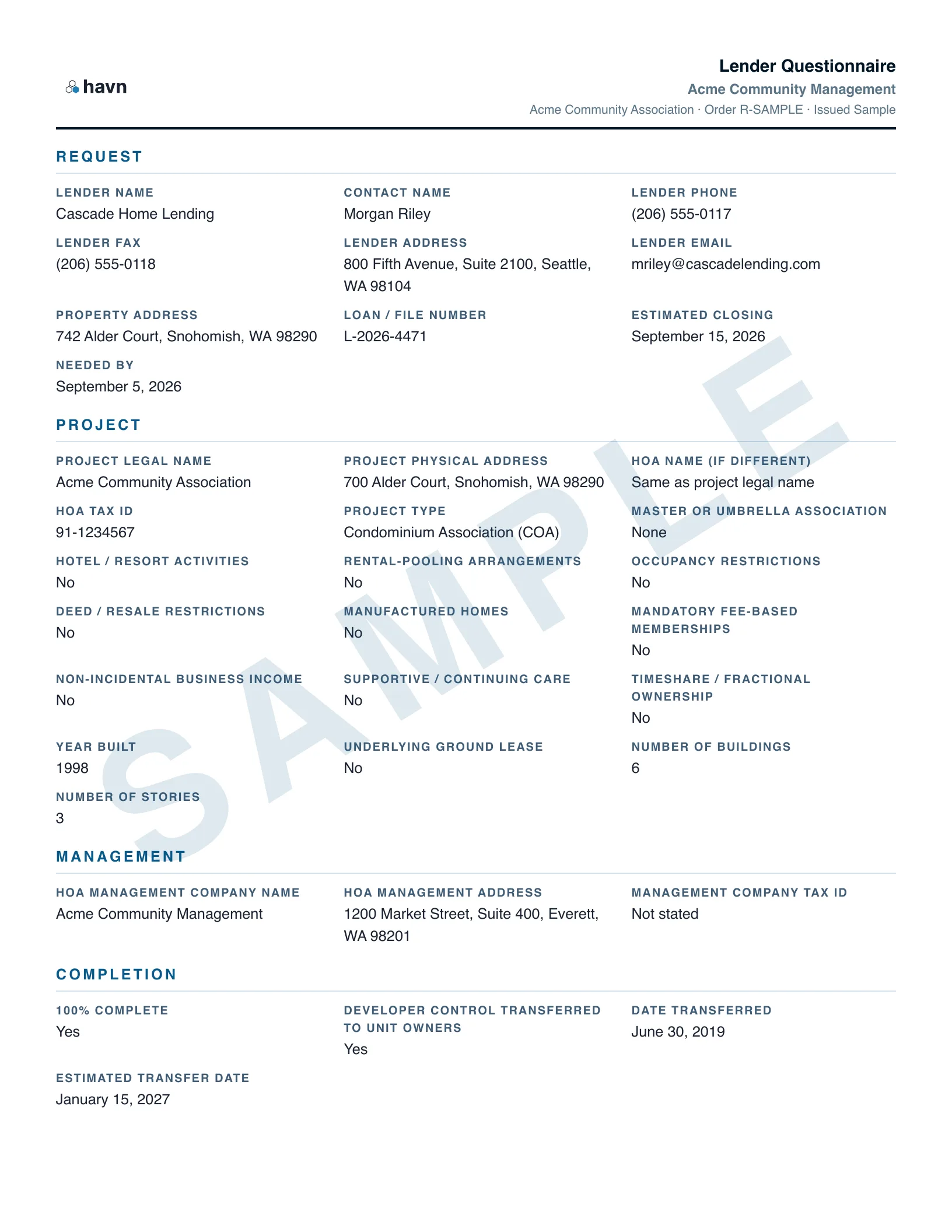
When a buyer or owner applies for a mortgage, the lender sends the association a condo questionnaire. Havn answers it from the community's records, on the lender's own form or Fannie Mae Form 1076, and hands it to you to review and sign.
Free for the resale platform. No contract to sign.
Lender Questionnaire
Example Ridge Owners Association
Units in the project
48
Owner-occupied units
39
Units 60 days past due
1
Reserve balance
$184,200.00
Why boards and managers choose Havn
Save hours on every order
Each document opens mostly written from the community's own records. You answer what only you know, review, and sign.
Sign up and take orders today
Create an account, add your community, and share your branded order link. No contract, no sales call, no onboarding project.
Stop worrying about state law
Fee caps, delivery deadlines, and required disclosures are built in state by state and checked on every order.
What is a condo questionnaire?
A condo questionnaire is a form a mortgage lender sends to a condominium or homeowners association before it approves a loan on a home in the community. The answers tell the lender whether the project meets its rules: how many owners live there, how many are behind on dues, what is in reserves, and whether the association is being sued.
It also goes by lender questionnaire, HOA questionnaire, and condominium project questionnaire. The standard version is Fannie Mae Form 1076, which Freddie Mac publishes as Form 476.
Sources: Fannie Mae project standards, Freddie Mac condominium unit mortgages, and the blank Form 1076.
What is on a condo questionnaire?
Fannie Mae Form 1076 has seven sections and an addendum. They cover the project's basics, whether construction is complete, recent conversions, delinquencies and lawsuits, who owns the units, insurance and financial controls, and who prepared the form. The addendum, added in December 2021, asks about building safety, deferred maintenance, reserves, and special assessments.
Who fills out a condo questionnaire?
The association does, through its management company or a board officer. A buyer, seller, or real estate agent cannot complete it. The lender needs answers from the party that holds the records, and the person who prepares the form signs it.
Who pays for the condo questionnaire?
The lender orders it, and the fee is normally passed to the borrower as a closing cost. In a purchase, the contract can assign it to the seller instead. Fannie Mae and Freddie Mac do not pay for it and do not set the fee.
How much does a condo questionnaire cost?
The association or its management company sets the fee, and it varies by company, by form, and by how fast the lender needs it back. Fannie Mae and Freddie Mac do not cap it. Where a state limits the fee, that limit controls.
How do you get a condo questionnaire?
The lender requests it from the association's management company, or from the board if the community manages itself. Many companies take the request through an online order page, where the lender uploads its form and pays. A buyer who needs one should ask the loan officer to order it, since the form goes back to the lender.
How long does it take to get a condo questionnaire?
The lender writes a return date on the form, and the loan cannot close without it, so most are needed within days. How fast it comes back depends on how quickly the association can pull its occupancy, delinquency, reserve, and insurance figures. Havn keeps those answers ready in the community record.
What Fannie Mae Form 1076 asks, section by section
Form 1076 is the Condominium Project Questionnaire. Freddie Mac publishes the same form as Form 476. It runs eight pages: seven sections, then an addendum that applies to condominiums and cooperatives.
IBasic Project Information
Legal name, addresses, tax IDs, any master association, and whether the project has hotel or rental-pooling activity, resale restrictions, manufactured homes, mandatory memberships, business income, or continuing care.
IIProject Completion Information
Whether the project is 100 percent complete, how it is phased, and whether the developer has turned control of the association over to the owners.
IIINewly Converted or Rehabilitated Project Information
Whether the building was converted from another use within the past three years, in what year, and whether the work was a full gut rehabilitation.
IVFinancial Information
How many owners are 60 or more days behind on assessments, what a foreclosing lender owes in back dues, and any active or pending litigation.
VOwnership and Other Information
How many units are owner-occupied, second homes, or rented, whether one owner holds several units, who owns the amenities, and how much of the building is commercial space.
VIInsurance Information and Financial Controls
Flood zone status, how the association's bank accounts are controlled, and the carrier, agent, and policy number for each policy.
VIIContact Information
The name, title, and signature of the person who prepared the form, and the date.
AddendumBuilding Safety, Soundness, Structural Integrity, and Habitability
Findings from the last inspection, known deficiencies, open code violations, the plan and schedule for deferred maintenance, the reserve study, the reserve balance, and current or planned special assessments.
Which answers make a condo ineligible for a loan?
Lenders call a project that fails these tests non-warrantable. A conventional lender cannot sell the loan to Fannie Mae, so most will not make it. That is why the answers on a questionnaire matter to every owner in the building, not only the one selling.
Sources: Fannie Mae Selling Guide, Ineligible Projects and Full Review Process. Freddie Mac and individual lenders set their own limits.
Under Fannie Mae's standards, a project generally fails when:
- More than 15 percent of the units are 60 or more days past due on assessments.
- The budget puts less than 10 percent of assessment income toward replacement reserves.
- One owner holds more than 20 percent of the units in a project of 21 or more units.
- More than 35 percent of the project or its building is commercial space.
- The building needs critical repairs, has significant deferred maintenance, or is under an evacuation order.
Three ways to answer a lender questionnaire
Lenders do not agree on one form. The lender picks the format when it orders through your branded order portal, and you set a price for each. See how pricing works.
Havn's standard questionnaire
A complete questionnaire that covers what lenders ask, laid out so an underwriter can read it fast. Used when the lender has no form of its own.
Fannie Mae Form 1076
The official form, which Freddie Mac publishes as Form 476, with every answer placed in its box and the December 2021 addendum included.
The lender's own form
The lender uploads its PDF when it orders. Havn prepares that form the first time it sees it, then fills it on every later order.
How a lender questionnaire order works in Havn
The lender orders and pays on its own. The questionnaire opens with most answers in place, drawn from your community records. You finish what only you know, sign, and send.
01
The lender orders
A loan processor orders through your branded portal, picks the format or uploads the lender's form, and pays by card.
02
Havn answers it
Occupancy, delinquency, reserve, insurance, and litigation answers come out of the community's records, each one traceable to its source.
03
You review and sign
Answer what only you know, preview the finished form, and sign as the preparer.
04
The lender gets it
A tracked link goes to the lender under your brand. The fee settles to your own bank account.
Questions boards and managers ask about lender questionnaires
Is there still a limited review condo questionnaire?
Not in Fannie Mae's current Selling Guide, which no longer lists a limited review. For an attached unit in an established project, the lender completes a full review, relies on an FHA project approval, or asks Fannie Mae to review the project, and Fannie Mae waives the project review for some loans. Lenders still call their shorter forms limited review questionnaires, and Havn fills those like any other lender form.
Does a conventional loan require a condo questionnaire?
Usually, for an attached condominium. Fannie Mae and Freddie Mac require the lender to review the project before they buy the loan, and the questionnaire is how the lender collects the answers. FHA loans rely on FHA's own project approval, which uses the FHA Condominium Project Approval Questionnaire, form HUD-9992.
Is an HOA questionnaire different from a condo questionnaire?
Lenders review condominium projects more closely than planned communities, so the full questionnaire is mostly a condominium document. Lenders still send shorter HOA questionnaires for homes in planned communities, asking about dues, lawsuits, and special assessments. Havn answers both from the same records.
Can an HOA refuse to fill out a condo questionnaire?
No federal rule forces an association to answer, and few states require it. Refusing usually stops the loan, which costs an owner a sale or a refinance. Many associations answer what their records support and mark the rest unknown, often on their attorney's advice, especially on the building safety addendum.
What does a lender questionnaire cost the association?
Nothing on the resale platform. The lender pays for the questionnaire when it orders, and you set that price.
Who is responsible for the answers?
The person who signs. Havn drafts the answers from your records and shows where each one came from. A manager or board officer reviews, corrects, and signs as the preparer.
Does Havn work with any lender's form?
Yes. The lender uploads its form as a PDF when it orders. Havn prepares that form the first time it sees it, then reuses the work on every later order from any lender that sends the same form.
A sale needs more than the questionnaire. See how Havn prepares HOA and condo resale certificates in every state, and HOA estoppel letters, and demand letters.
Your next lender questionnaire could answer itself.
The resale platform is free for the association. The lender pays for the document. No contract to sign.