HOA Estoppel Letters
HOA Estoppel Letters and Certificates, Prepared From Your Records
Before a sale or refinance closes, the title company asks the association what the home owes. Havn drafts that estoppel letter from the community's records, in Florida's statutory form where the law prescribes one, and hands it to you to review and sign.
Free for the resale platform. No contract to sign.
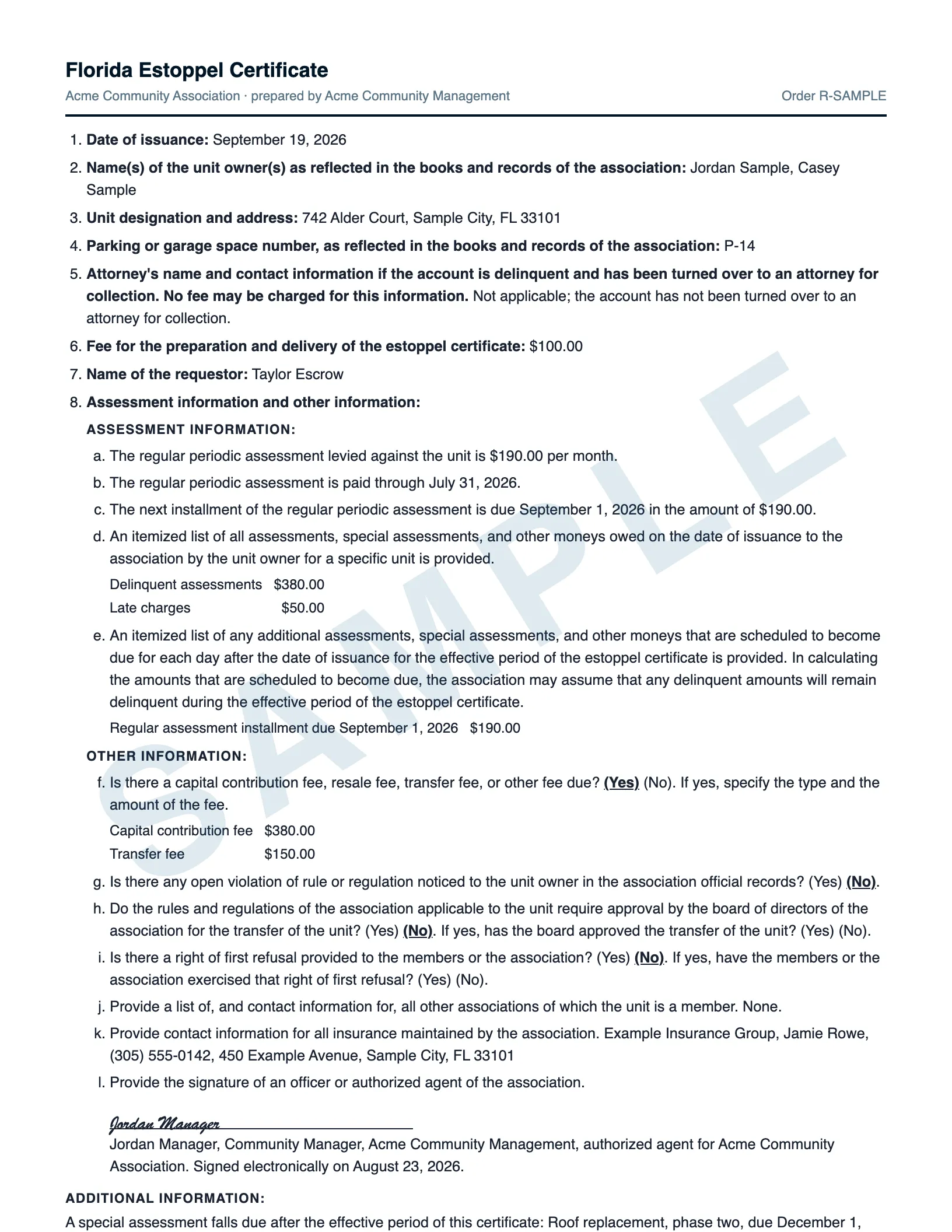
Florida Estoppel Certificate
Example Ridge Owners Association
Regular assessment
$190.00 monthly
Paid through
August 31, 2026
Owed on the date of issuance
$0.00
Open violations
None
Why boards and managers choose Havn
Save hours on every order
Each document opens mostly written from the community's own records. You answer what only you know, review, and sign.
Sign up and take orders today
Create an account, add your community, and share your branded order link. No contract, no sales call, no onboarding project.
Stop worrying about state law
Fee caps, delivery deadlines, and required disclosures are built in state by state and checked on every order.
What is an HOA estoppel letter?
An HOA estoppel letter is a statement from the association of exactly what a home owes it as of a given date: assessments, special assessments, fines, fees, and anything else coming due through closing. The title or closing company orders it before a sale or refinance and uses it to pay the association in full at the closing table.
It is also called an estoppel certificate, a payoff statement, a statement of account, a closing letter, and a demand letter. Florida is the only state whose statutes name it an estoppel certificate and prescribe its contents, for condominiums, cooperatives, and homeowners associations alike.
Florida statutes: Fla. Stat. 718.116(8), Fla. Stat. 719.108(6), and Fla. Stat. 720.30851.
Why does a closing need an estoppel letter?
Unpaid association debts follow the home. The association can place a lien on it, and in many states a buyer can be held liable for what the seller left unpaid. The letter gives the closing agent one number to pay the association from the seller's proceeds, so the buyer starts at zero and the title is clean.
What does estoppel mean for an HOA?
Estoppel is a legal rule that holds a party to what it has said. Once the association states in writing what a home owes, a buyer or lender who relies on that statement in good faith cannot later be charged more. Florida writes that protection into its statutes.
Who can request an HOA estoppel letter?
In Florida, the owner or the owner's designee, or a mortgage lender or its designee. In practice the title or closing company orders it on the owner's behalf. Elsewhere the association decides who may order, and most accept requests from owners, title companies, and lenders.
Who pays the HOA estoppel fee?
The closing agent orders the letter and the cost is settled at closing. It usually falls on the seller, who has to deliver the home free of association debts, but the purchase contract can assign it to the buyer. In a refinance the owner pays. In Florida the fee is payable when the certificate is prepared, never in advance.
What is an HOA estoppel fee?
It is what the association or its management company charges to prepare and deliver the estoppel letter. It pays for pulling the account, checking for violations and pending assessments, and standing behind the figures. It shows up on the settlement statement as a closing cost.
How much is an estoppel fee in Florida?
No more than $299. A rush certificate, requested on an expedited basis and delivered within 3 business days, can add $119. A delinquent account can add up to $179. The statute itself still prints $250, $100, and $150. Those are the 2017 amounts. The state adjusts them for inflation every five years and publishes the current figures, next by July 1, 2027. Lower combined caps apply when one owner requests many units at once.
How do you get an HOA estoppel letter?
The closing agent requests it from the association's management company, or from the board if the community manages itself. A Florida association has to name on its website a person or entity, with a street or email address, to receive estoppel requests. Many companies take the request through an online order page instead.
How long does it take to get an estoppel letter?
Florida gives the association 10 business days from a written or electronic request. If it misses that deadline, it cannot charge a fee at all. Deadlines elsewhere vary by state and by document.
How long is an estoppel letter good for?
In Florida, 30 days when it is delivered by hand or electronically, and 35 days when it is mailed. If the association finds a mistake inside that period and before closing, it issues an amended certificate at no charge, and the period starts again.
What a Florida estoppel certificate must include
Florida's statutes list the contents item by item, and the list is the same for condominiums, cooperatives, and homeowners associations. A certificate that skips an item is not the statutory form.
The request
- Date of issuance
- Names of the owners as shown in the association's books and records
- Unit or parcel designation and address
- Parking or garage space number
- The collection attorney's name and contact information, if the account has been turned over
- The fee for preparing and delivering the certificate
- Name of the requestor
Assessment information
- The regular periodic assessment and how often it is levied
- The date the assessment is paid through
- The date and amount of the next installment
- An itemized list of everything owed on the date of issuance
- An itemized list of what is scheduled to come due during the certificate's effective period
Other information
- Any capital contribution, resale, transfer, or other fee due, with its type and amount
- Any open violation noticed to the owner in the official records
- Whether the board must approve the transfer, and whether it has
- Any right of first refusal, and whether it has been exercised
- Every other association the home belongs to, with contact information
- Contact information for all insurance the association maintains
- The signature of an officer or authorized agent
Do other states have estoppel letters?
Only Florida's statutes call the document an estoppel certificate. Other states get to the same place by another name: the association must state what a home owes, and a buyer or lender who relies on that statement is protected. Arizona's fee statute comes closest to the word, listing lien estoppel among the transfer services an association may charge for.
These are the clearest examples. In states that set nothing, title companies still ask for the letter, and associations furnish it under their governing documents.
Estoppel letter, resale certificate, or demand letter?
Three names that overlap. Which one you are asked for depends on the state and on who is asking. The state map shows what each state calls its document.
Estoppel letter or certificate
What the home owes through closing, in a form the association is held to.
Named and prescribed by statute in Florida only. Other states require the same binding statement under other names.
Resale certificate
A disclosure about the whole association: finances, reserves, insurance, lawsuits, rules, and what the home owes.
Required by statute in 34 of the 51 jurisdictions, under many names.
Demand letter or payoff statement
The amounts to collect at closing, ordered by the escrow or title company.
The usual name in escrow states such as California and Arizona.
Havn prepares all three. See HOA and condo resale certificates and lender questionnaires, and how a closing demand letter works in other states.
How an estoppel order works in Havn
The closing agent orders on its own through your branded order portal. The certificate opens with most answers in place, drawn from your community records.
01
The closing agent orders
A title or closing company orders through your branded portal. Florida orders are billed after the certificate is prepared, as the statute requires.
02
Havn drafts the statutory form
Assessments, the paid-through date, amounts owed, and amounts coming due are drawn from the community's records, item by item in the statute's order.
03
You review and sign
Answer what only you know, such as open violations and board approval, preview the certificate, and sign as the authorized agent.
04
The closing agent gets it
A tracked link goes out the day it is issued. Havn watches the deadline on every Florida order, and a late certificate cannot carry a fee.
Questions boards and managers ask about estoppel letters
Are estoppel certificates required in Florida?
Yes. A Florida condominium, cooperative, or homeowners association must issue one within 10 business days after a written or electronic request from an owner, a mortgage lender, or either one's designee, and deliver it by hand, mail, or email on the day it is issued. If it refuses, the requester can go to court to compel it, and the winning side recovers attorney fees.
What does an estoppel letter cost the association?
Nothing on the resale platform. The requester pays the estoppel fee, and you set it within what your state allows.
Can a Florida association collect the estoppel fee up front?
No. The fee is payable when the certificate is prepared. An association also needs authority to charge it at all: a written board resolution, or a written management, bookkeeping, or maintenance contract. If the sale does not close, a payor other than the owner can ask for a refund in writing within 30 days after the scheduled closing date.
Is a free HOA estoppel letter template enough?
Not in Florida. The statute lists what the certificate must contain, and a generic template can leave items out. The association is also held to the numbers it writes, so a wrong figure becomes the association's loss. Havn prints the statutory items in order and fills them from your records.
Is an HOA estoppel letter the same as a tenant estoppel certificate?
No. A tenant estoppel certificate is a lease document: a tenant confirms the rent and terms of a lease for a landlord's buyer or lender. An HOA estoppel letter comes from a community association and states what a home owes it.
Who is responsible for the amounts in the letter?
The association, through the person who signs. Anyone who relies on the letter in good faith cannot be charged more than it states. Havn drafts the figures from your records and shows where each one came from, and a manager or officer reviews and signs.
Does Havn handle payoff requests outside Florida?
Yes. Other states call the same request a demand letter, a payoff statement, a statement of account, or a closing letter. Havn prepares it in every state, with that state's fee limit applied where one exists.
Your next estoppel letter could write itself.
The resale platform is free for the association. The requester pays for the document. No contract to sign.