Demand Letters
HOA Demand Letters and Payoff Statements, Drafted From Your Records
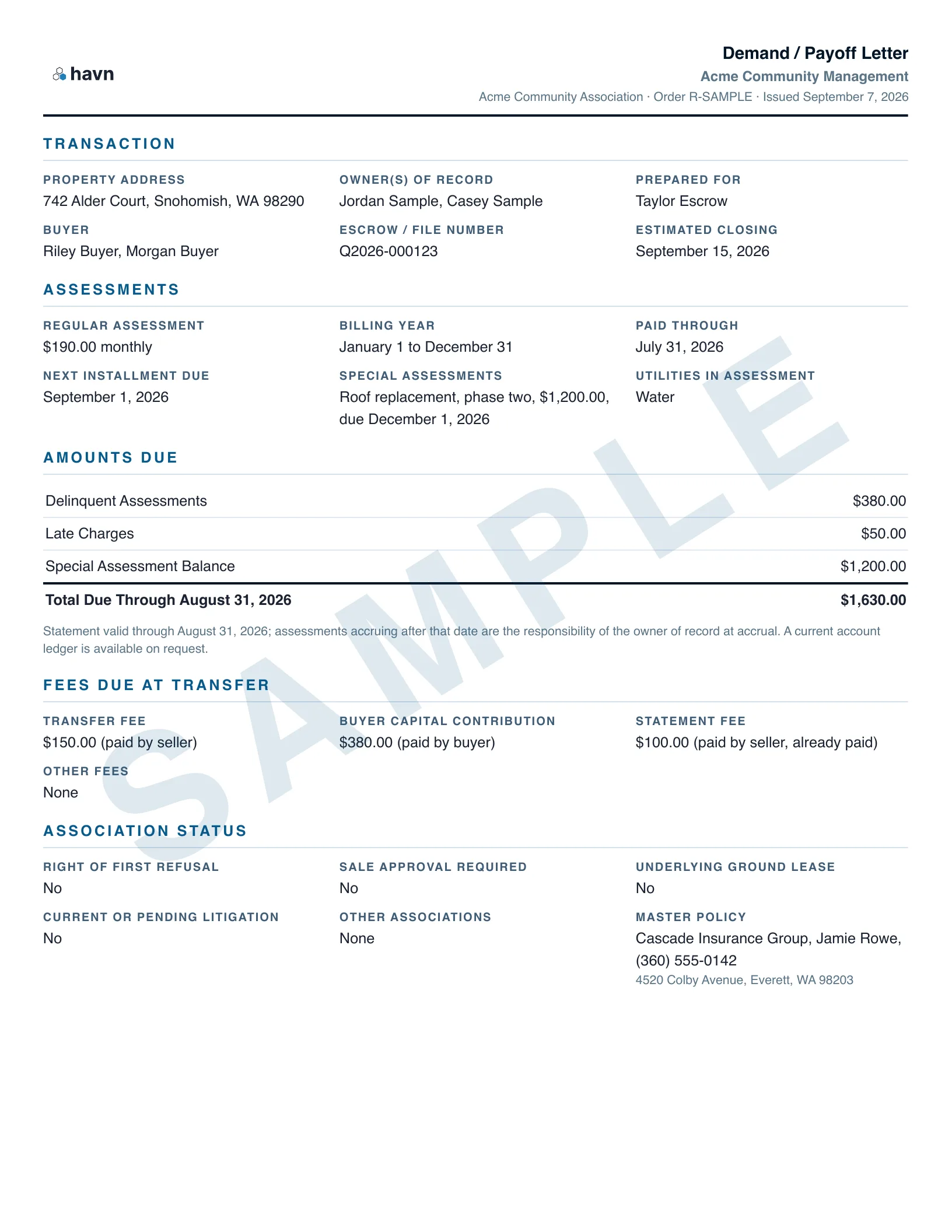
Before a closing, the escrow or title company asks the association for a payoff: what the home owes through the closing date and which fees are due at transfer. Havn drafts that statement from the community's records and hands it to you to review and sign.
Free for the resale platform. No contract to sign.
Demand Letter
Example Ridge Owners Association
Regular assessment
$190.00 monthly
Paid through
July 31, 2026
Total due through closing
$1,630.00
Transfer fee
$150.00
Why boards and managers choose Havn
Save hours on every order
Each document opens mostly written from the community's own records. You answer what only you know, review, and sign.
Sign up and take orders today
Create an account, add your community, and share your branded order link. No contract, no sales call, no onboarding project.
Stop worrying about state law
Fee caps, delivery deadlines, and required disclosures are built in state by state and checked on every order.
What is an HOA demand letter?
In a home sale, an HOA demand letter is the association's written statement of what has to be paid at closing: unpaid assessments, late charges, special assessments, and the transfer and other fees due when the home changes hands. The escrow or title company requests it, which is why it is also called an escrow demand or a payoff demand.
The same words also name a collections letter: the demand for payment an association or its attorney sends an owner who has fallen behind. That is a different document, and this page is about the closing demand.
Other names for it: payoff statement, statement of account, statement of unpaid assessments, closing letter, and in Florida an estoppel letter.
What does an HOA demand letter include?
The property, the owners of record, and the escrow number and closing date. The regular assessment, what it is paid through, and the next installment. An itemized list of amounts due, with a total good through a stated date. The fees due at transfer and who pays each. Whether a sale needs approval or triggers a right of first refusal. And where to send the check.
Why does escrow need an HOA demand?
Unpaid association debts follow the home, and the association can place a lien for them. The demand gives the escrow officer one total to pay from the seller's proceeds, so the association is paid in full, the buyer starts at zero, and the title company can insure the sale.
Who orders the HOA demand?
The escrow officer, title company, or closing attorney handling the sale, because they are the ones who pay the association out of the closing. An owner can request one too, and so can a lender in a refinance.
Who pays for an HOA demand letter, and what does it cost?
The fee is a closing cost and usually falls on the seller, though the purchase contract can move it. What it costs is set by the association or its management company, within what the state allows, so it varies from one community to the next. In Arizona it counts toward one combined cap of $400 on all transfer services and can be collected no earlier than the close of escrow. Utah caps it at $50, allows it only where the governing documents authorize a fee, and bars requiring payment before closing.
How long does an association have to provide a payoff statement?
It depends on the state, and where a statute sets a deadline it is short. The table below lists the ones Havn tracks. Where the state is silent, the closing date sets the pace, and a late demand delays the closing.
What happens if the association answers late?
In three states it can lose its lien. Arizona gives the association ten days after an escrow agent's request, and missing it extinguishes the lien for the unpaid assessments then due. Georgia gives five business days after a written request, and missing it extinguishes the lien against what the buyer or lender acquires. Utah gives five business days after a proper request from the closing agent, and an association that misses it cannot enforce its lien for the money due at closing.
What is an HOA closing letter?
It is the name Georgia closings use for the same document. Georgia's statutes call it a statement of account: the assessments past due and unpaid, with late charges and interest, furnished within five business days of a written request and binding on the association. The statute lets the association require a fee of no more than $10 for that statement, and only where the governing documents provide for one. Management companies often prepare a fuller closing letter under the governing documents, priced separately.
How long is an HOA demand good for?
A demand states the date its total is good through. If the closing moves past that date, the escrow officer asks for an update, because another installment or late charge may have come due. Florida is the exception that sets the period by statute.
A closing demand is not a collections demand letter
People search one phrase for two documents. If an owner has fallen behind and you need to demand payment, that is the letter on the right, and it is not what Havn prepares.
Who sends it
Closing demandThe association or its management company, in answer to a request.
Collections demand letterThe association or its attorney, on its own initiative.
Who receives it
Closing demandThe escrow officer, title company, or closing attorney.
Collections demand letterAn owner who is behind on assessments.
When
Closing demandDays or weeks before a sale or refinance closes.
Collections demand letterAfter an account goes delinquent, usually before a lien is recorded.
What it does
Closing demandStates the payoff so the association is paid in full from the closing.
Collections demand letterDemands payment and warns of a lien, late charges, or legal action.
What follows
Closing demandA check from escrow and a clean account for the buyer.
Collections demand letterPayment, a payment plan, or a lien and collection.
Payoff statement deadlines by state
Where a statute sets a deadline for the association's payoff statement, Havn tracks it on every order. These are the ones Havn tracks, shortest first.
Statutes for the three states where a late answer costs the association its lien: A.R.S. 33-1256, A.R.S. 33-1807, O.C.G.A. 44-3-109, O.C.G.A. 44-3-232, Utah Code 57-8-6.3, Utah Code 57-8a-106.
For the statutes behind these and the other states that require a binding payoff statement, see the list on the estoppel page. Resale certificate deadlines are on the state map.
Virginia
3 business days
Financial update
Georgia
5 business days
Statement of account. A late answer costs the lien.
Utah
5 business days
Payoff information. A late answer costs the lien.
Tennessee
7 days
Statement of unpaid assessments
Arizona
10 days
Statement of unpaid assessments. A late answer costs the lien.
Connecticut
10 business days
Statement of unpaid assessments
Florida
10 business days
Estoppel letter
Rhode Island
10 business days
Statement of unpaid assessments
West Virginia
10 business days
Statement of unpaid assessments
Washington
15 days
Statement of unpaid assessments
How a demand letter order works in Havn
The closing agent orders on its own through your branded order portal. The letter opens with most answers in place, drawn from your community records.
01
Escrow orders
An escrow officer or title company orders through your branded portal, enters the escrow number and closing date, and pays by card.
02
Havn drafts it
Assessments, the paid-through date, amounts due, and fees at transfer are drawn from the community's records, each one traceable to its source.
03
You review and sign
Check the total and its good-through date, answer what only you know, preview the letter, and sign.
04
Escrow gets it
A tracked link goes to the closing agent under your brand, with remittance instructions. The fee settles to your own bank account.
Questions boards and managers ask about demand letters
What is an HOA statement of account?
The phrase covers two things. To an owner, it is the ledger of charges and payments on the account. At a closing, it is the payoff figure the association certifies to the escrow or title company, which is the document on this page. Some states, Georgia among them, use statement of account as the statutory name for that closing document.
What does a demand letter cost the association?
Nothing on the resale platform. The requester pays for the demand when it orders, and you set that price within what your state allows.
Does Havn send collections demand letters?
No. Havn prepares the closing demand: the payoff statement an escrow or title company orders. A collections demand to a delinquent owner is a different document with its own notice rules, and it is usually sent by the association's attorney.
Is an HOA demand letter the same as a resale certificate?
No. A demand states what the home owes. A resale certificate is a broader disclosure about the whole association: its finances, reserves, insurance, lawsuits, and rules, along with what the home owes. Many sales need both, and Havn fills both from the same records.
Why do California, Arizona, and Nevada call it a demand?
Closings in those states run through escrow companies, and escrow officers speak of demanding a payoff from anyone owed money at closing, lenders and associations alike. Nevada's statute uses the word itself and calls the document a statement of demand. Arizona's calls it a statement of unpaid assessments.
Who is responsible for the figures?
The association, through the person who signs. In many states the statement binds the association, so an amount left off is the association's loss. Havn drafts the figures from your records and shows where each one came from, and a manager or officer reviews and signs.
Is a free HOA statement of account template enough?
A template gives you the layout, not the numbers. The work is pulling the ledger, the paid-through date, pending special assessments, and the fees due at transfer, and getting the total right as of a date. That is the part Havn does from your records.
A closing usually needs more than the demand. See HOA and condo resale certificates, lender questionnaires, and HOA estoppel letters.
Your next demand letter could draft itself.
The resale platform is free for the association. The requester pays for the document. No contract to sign.